The central idea of the book is simple: many businesses do not fail because the owner lacks ambition. They struggle because the company does not have a clear system. People work hard, but they may not be working in the same direction. Teams hold meetings, but the meetings do not solve the real issues. Leaders create goals, but those goals are not tracked consistently. Wickman calls his framework the Entrepreneurial Operating System, often known as EOS. The book explains how EOS helps a company gain “traction,” meaning the ability to turn vision into measurable progress.
What Is Traction About?
Traction is built around six key components that every business needs to strengthen: Vision, People, Data, Issues, Process, and Traction. Wickman argues that when these six areas are weak, a company becomes chaotic. When they are strong, the business becomes easier to manage and more likely to grow sustainably.
The first component, Vision, focuses on getting everyone in the organization aligned. This sounds basic, but many companies have unclear visions. The founder may know what they want, but the team may not fully understand the direction. Wickman encourages businesses to answer essential questions: What are the company’s core values? What is its core focus? What is the 10-year target? What are the marketing strategies? What are the one-year and quarterly goals? By forcing leaders to clarify these points, the book helps turn vague ambition into a shared roadmap.
The People component is equally important. Wickman does not simply say that companies need good people; he gives readers a method for evaluating whether the right people are in the right seats. This is one of the strongest parts of the book because it addresses a painful truth in business: sometimes the problem is not the strategy, but the team structure. A talented person in the wrong role can still create friction. A loyal employee who does not match the company’s core values may hold the organization back. The book presents this subject in a direct but practical way.
The Data component is about managing the business through numbers rather than feelings. Many entrepreneurs rely heavily on instinct, and while instinct can be valuable, it is not enough to run a growing company. Wickman recommends building a scorecard with a small number of key metrics that can be reviewed weekly. This allows leaders to identify problems before they become serious. For example, instead of waiting until revenue drops at the end of the month, a company can track leads, conversions, production numbers, customer complaints, or cash flow indicators every week.
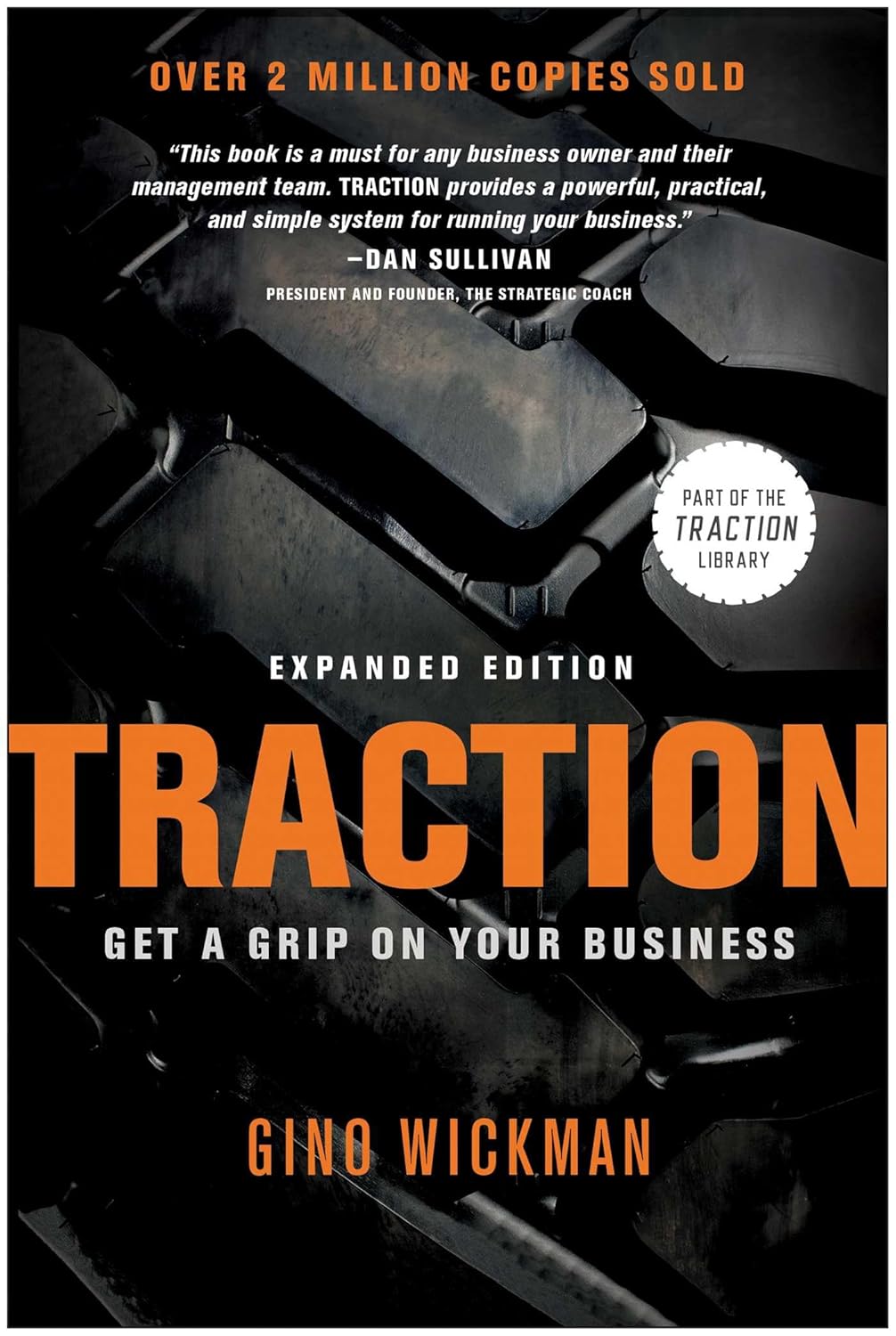
Traction: Get a Grip on Your Business Review – A Practical Book for Entrepreneurs Who Want Real Growth
Why This Book Is Valuable for Business Owners
One of the biggest strengths of Traction is that it is extremely action-oriented. Some business books are inspiring but leave readers wondering what to do next. This book is different. It gives readers tools, meeting structures, worksheets, and specific steps that can be implemented inside a real business. The writing style is straightforward, making it suitable for busy entrepreneurs who do not have time for abstract business philosophy.
The Issues component is especially useful because many companies suffer from unresolved problems. In some organizations, leaders talk around issues instead of solving them. In others, the same problems appear again and again because nobody identifies the root cause. Wickman introduces the IDS method: Identify, Discuss, and Solve. This framework helps teams stop wasting time on surface-level complaints and start dealing with the real obstacles.
The Process component focuses on documenting the core processes that make the business work. This may sound boring at first, but it is essential for scaling. If every task depends on one person’s memory or personal style, the business becomes fragile. By documenting core processes, a company can train new employees faster, reduce mistakes, maintain quality, and create consistency. This is particularly valuable for service businesses, agencies, construction companies, education centers, clinics, retail operations, and other businesses that depend on repeatable execution.
The final component, Traction, is about discipline. Wickman emphasizes quarterly priorities, weekly meetings, and clear accountability. In the EOS model, companies set “Rocks,” which are major priorities for the quarter. This concept is powerful because it prevents teams from chasing too many goals at once. Instead of trying to do everything, the company identifies the most important priorities and commits to completing them.
Another reason this book stands out is that it understands the emotional reality of entrepreneurship. Running a business can be exhausting. Owners often feel trapped between growth ambitions and daily problems. They may be pulled into operations, sales, finance, HR, customer service, and crisis management all at the same time. Traction does not promise a magical solution, but it gives business owners a way to regain control. That is why the subtitle, “Get a Grip on Your Business,” feels accurate.
Who Should Read Traction?
This book is best suited for entrepreneurs, small business owners, startup founders, CEOs, general managers, and leadership teams. It is especially helpful for companies that already have some revenue, employees, customers, and operational complexity. A solo freelancer may still learn useful ideas from the book, but the full EOS system becomes more valuable when there is a team to align and manage.
Businesses with 10 to 250 employees may find the book particularly relevant. These companies are often past the survival stage but not yet fully systemized. They may have customers and cash flow, but they also experience growing pains. Common problems include unclear responsibilities, weak middle management, inconsistent sales processes, poor meeting habits, and a lack of measurable goals. Traction directly addresses these issues.
For readers who enjoy highly academic business books, Traction may feel simple. However, that simplicity is also its advantage. Wickman is not trying to create a complex theory of management. He is offering a practical operating system that real companies can use. The book’s value comes from execution, not just reading. A reader who only reads the book casually may find it useful, but a leadership team that actually applies the tools can see much greater benefits.
One small limitation is that implementing EOS requires discipline and commitment. The book may make the system look simple, but changing how a company operates is not always easy. Some employees may resist accountability. Some leaders may struggle to follow meeting rhythms. Some founders may find it difficult to delegate or define roles clearly. Therefore, readers should understand that Traction is not just a book of ideas; it is a management framework that requires consistent practice.
Overall, Traction: Get a Grip on Your Business is a highly useful business book for anyone who wants to move from chaos to clarity. It is not about motivational slogans or quick success. It is about building the habits, systems, and accountability needed to run a stronger business. Gino Wickman presents business management in a way that is simple, structured, and practical. For entrepreneurs who feel stuck, overwhelmed, or frustrated by lack of execution, this book offers a clear path forward.
In conclusion, Traction deserves its reputation as one of the most practical books for small and mid-sized business owners. It helps readers understand that growth is not only about having a great product, strong marketing, or more sales. Sustainable growth also depends on vision, people, numbers, problem-solving, processes, and disciplined execution. If you are serious about building a business that can operate with more clarity and less chaos, this book is worth reading and, more importantly, worth implementing.